Manufacturer of refractory bricks for coke ovens. Low price for sale.
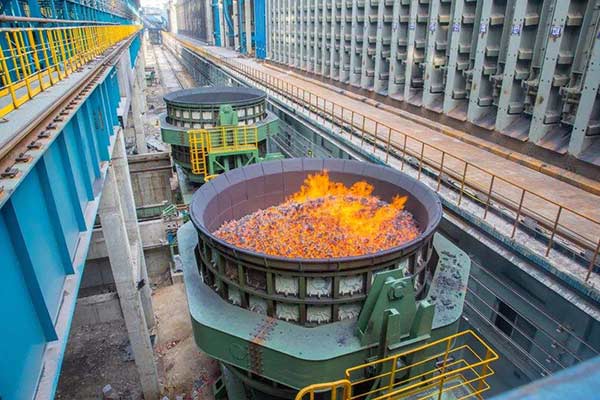
What is the structure of a coke oven body? And what kind of refractory materials are used? According to the experts of Henan PER Refractories Factory, a coke oven is thermal equipment for dry distillation of coal to obtain coke and chemical products, mainly composed of a carbonization chamber, combustion chamber, Dach, ramp, heat storage chamber, and small flue, etc.
1. Refractory materials for the carbonization chamber. The work of the charring chamber is cyclical, the surface temperature of the furnace wall drops to about 600’C when coal is loaded, and the surface temperature of the furnace wall rises to 1000-1100℃ at the end of coking.
daher, the walls and bottom of the charring chamber are built with silicon bricks. The head of the charring room at both ends, aufgrund der plötzlichen Temperaturänderung beim Öffnen der Ofentür, Tropfen aus 10 00’C auf unter 500℃, die den Temperaturgrenzwert überschreitet (573℃) der Volumenstabilität von Siliziumbausteinen.
daher, Der Herdkopf sollte mit Produkten mit guter Temperaturwechselbeständigkeit ausgewählt werden, Die meisten der bisherigen Optionen sind Lehmziegel, Heutzutage neigen sie dazu, hochwertige Ziegel mit hohem Aluminiumoxidgehalt zu wählen, Steinziegel der Silica-Linie, und rotes Säulensteinmauerwerk.
2. Brennkammer mit feuerfesten Materialien. Brennraum und Schwelraum teilten sich eine Ofenwand, das gleiche wie der Karbonisierungsraum mit Ziegeln.
3. Heißluftofendach mit feuerfesten Materialien. Ofendach um die Kohleladeöffnung aufgrund von Temperaturschwankungen, mit Ziegelmauerwerk, andere Teile mit Silikonmauerwerk.
4. Feuerfestes Material für die Rampe. Die Rampe verbindet die Brennkammer mit der Wärmespeicherkammer, Dies erfordert eine stabile Ziegelstruktur und kann der Einwirkung thermischer Belastung standhalten. Kleine Koksöfen mit Lehmziegeln sowie große und mittlere Koksöfen verwenden Quarzsteinmauerwerk.
5. Feuerfeste Materialien für Wärmespeicherkammer. Die einzelne vertikale Wand, Trennwand, Boden- und Gitterziegelmauerwerk der Wärmespeicherkammer kleiner Kokereien werden aus Lehmziegeln errichtet, während das mittlere und obere Mauerwerk der Wärmespeicherkammer mittlerer und großer Koksöfen alle aus Quarzsteinen gebaut sind, so dass der gesamte Koksofen gleichmäßig erweitert werden kann.
6. kleiner Schornstein mit feuerfesten Materialien. Der kleine Kamin befindet sich am Boden der Wärmespeicherkammer und ist mit dem Kamin verbunden. All the small flue is lined with clay bricks.
Im Allgemeinen, the refractory material for the coke oven is mainly feuerfeste Kieselsäuresteine. Coke oven silica bricks require precise shape and size, and have high enough bulk density, Wärmeleitfähigkeit, high-temperature creep, and high-temperature strength; the composition of the physical phase in the brick is dominated by scaly quartz, and the less residual quartz the better.
The Coke oven is the basic equipment of a coking plant, which is a kind of thermal equipment with a complex structure and continuous production. The coke oven is composed of an incinerator, charring chamber, combustion chamber, heat storage chamber, Dach, ramp, small flue, and foundation.
The masonry of a 42-hole coke oven requires 6,557 tons of refractory materials, of which 4,352 Tonnen, oder 66.4%, are silica bricks. Coke ovens in 20 zu 25 years of the operation cycle, most of the masonry is not easy to hot repair. daher, the refractory materials for coke ovens must be able to adapt to the requirements of the coking production process and be durable and reliable.
Based on the characteristics of coke production, refractory materials for coke ovens have their basic requirements. The different parts of the coke oven body have different performances due to the different tasks, Temperatur, structural load, mechanical damage, and media erosion.
The partition wall between the coking room and the combustion chamber can reach a temperature of more than 1550°C in the main fire escape during normal production.
This wall is the carrier of the heat required for coking, which requires that the furnace material should have good high-temperature thermal conductivity.
This partition wall also bears the structural load of the upper masonry and the gravity of the coal-loading car at the top of the furnace. Gleichzeitig, it is required that the furnace material should have the performance of a high-temperature load without deformation.
The wall surface of the carbonization room is subject to the erosion of ash, Schlacke, Feuchtigkeit, and acid gas, methane also penetrates the brick voids to produce carbon deposits, and the bottom of the main fire escape is subject to the slagging erosion of coal dust and dirt. daher, it is required that the furnace material should have high-temperature corrosion resistance.
The temperature of the wall of the charring room drops sharply from about 1100℃ to 600-700c when coal is loaded, so the furnace material is required to have the performance of resistance to high-temperature drastic change above 600℃. Due to the influence of pushing coke, it also requires the carbonization chamber bottom brick to have high wear resistance performance.
The temperature difference between the inner and outer wall of the combustion chamber head is very different, and the temperature changes a lot when loading coal, and it is also affected by the pressure of the protection plate, which requires that the furnace building materials should have better resistance to drastic temperature changes and better pressure resistance.
The temperature difference between the upper and lower layers of the lattice brick used in the heat storage chamber reaches about 1000℃, and the temperature difference between the updraft and downdraft is between 300~, which requires the lattice brick material should have the characteristics of high bulk density and strong resistance to drastic temperature changes.
It is reported that the small flue in the updraft when the temperature is lower than 100 ℃, while in the down draft is higher than 300 ℃, refractory brick gas channel by the action of room temperature gas and water vapor, so both require furnace building materials in 300 ℃ below should have the performance of resistance to drastic changes in temperature.
Zusamenfassend, masonry refractory materials firebricks for coke ovens should have the following characteristics
The load softening temperature is higher than the maximum temperature of the used part.
Resistance to temperature changes within the temperature range of the part to be used.
Resistance to various media that may be encountered in the use area.
The charring chamber – combustion chamber wall has good thermal conductivity, and the lattice brick has good heat storage properties, etc.
The refractories firebricks, Wärmeleitfähigkeit, thermal expansion, Porosität, Schüttdichte, high-temperature load softening temperature, Volumenstabilität bei hohen Temperaturen, resistance to drastic temperature changes, etc. of commonly used refractory materials for coke ovens should meet the requirements.
Seit Oktober, Die Preise für Aluminiumoxid sind weiter gestiegen, and China's largest bauxite importer - a…
Erste, Ziegel mit hohem Tonerdegehalt: The Leader In High Temperature Refractories As a leader in high-temperature…
The application of refractory bricks in the kiln immediately endangers the operation rate of the…
Analysis Of The Causes Of Common Quality Problems In Tunnel Kiln Construction And Measures To…
Corundum quality refractory castables are made from corundum to the new jade refractory insulation material…
Analyse feuerfester Aluminium-Silizium-Rohstoffe Prof. Li Yong of the University of Science and…