Was ist geformter feuerfester Stein??
Geformte feuerfeste Steine, als Schamottsteine bezeichnet, kann verschiedenen physikalischen und chemischen Veränderungen sowie mechanischen Einwirkungen bei hohen Temperaturen standhalten. And shaped refractory bricks are refractory materials with certain shapes and sizes.
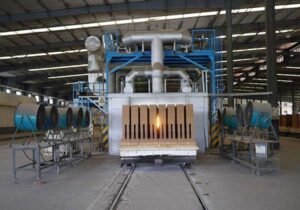
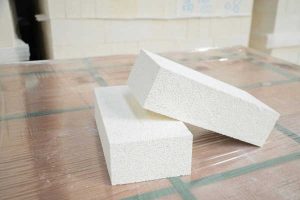
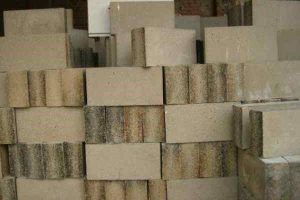
Geformte feuerfeste Steine can be divided into fired bricks, ungebrannte Ziegel, elektrogeschmolzene Ziegel (fused casting bricks), and refractory heat-insulating bricks according to the preparation process. Zusätzlich, special-shaped refractory bricks according to their shape and size can be divided into standard bricks, ordinary bricks, type of turn, und so weiter. Shaped refractory bricks can be used as high-temperature building materials and structural materials for construction kilns and various thermal equipment.
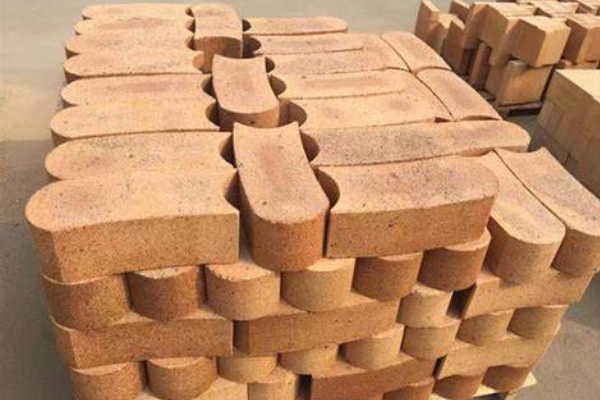
Zusammenhang zwischen Produktstruktur und Temperatur profilierter feuerfester Steine
The main feature of profiled refractory bricks is high early strength, 3-7 days maximum room temperature compressive strength up to 30MPa or more. The disadvantage is that the volume stability of the medium temperature is poor, the strength is reduced, and the maximum reduction can be up to 40% or so, so the requirement of room temperature compressive strength must meet the design and national standards requirements.
Its temperature strength reduction is the main factor: shaped refractory bricks of low-calcium high alumina cement in the heating furnace baking furnace warming process to reach a certain temperature (350 ℃ or so), hydride began to dewatering, the transformation of the hydride of the cementite structure, compactness and strength of the reduction in the volume of the castable material changes. Zu diesem Zeitpunkt, the strength of the castable body drops to the lowest point and then tends to stabilize.
As the heating temperature rises to 1100 ℃, cementite gradually sintered, shaped refractory brick crystal type began to transform mullite crystals. As the temperature continues to rise, mullite crystals continue to grow, the matrix glass phase in the casting material is a liquid state, the formation of high-temperature ceramic sintered shape, and the strength significantly increases. At about 1300 ℃, the strength of the shaped refractory brick body can reach more than 60MPa. This is a significant feature of shaped refractory bricks in the high-temperature state.
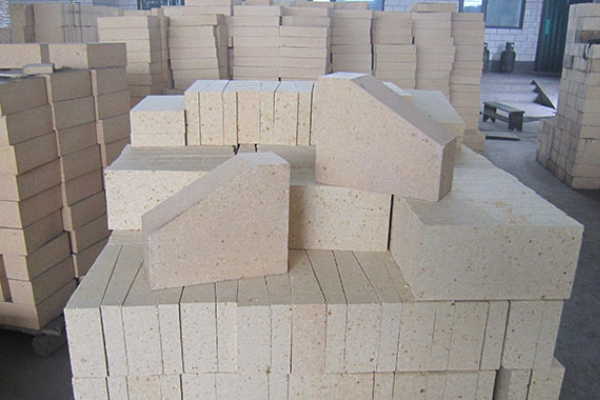
Shaped Brick: T46 High Alumina Arched Corner Brick
Arch brick is a commonly used refractory brick when masonry doors, generally used with standard refractory bricks and wedge-shaped refractory bricks. Attention needs to be paid to soffit masonry. Any soffit brick consists of a right triangle, d.h. the soffit brick has two angles of inclination which are mutually exclusive.
Zum Beispiel, the other angle of inclination of an arch block with an inclination angle Φ=520 is 380, so the 380 arch angle used for a vault with a center angle of 1040 can be used as the other angle of inclination of a 520 arch block. The two residual angles of the arch angle of the furnace roof with thicknesses of 380 Und 440 mm are sometimes used in this way. Auf diese Weise, the arch of the standard angle of inclination includes 300. 380, 450, 520, Und 600. arch corner brick bevel length L should be equal to the size of the head of the wedge with the distance b, generally used 114, 230, 300, 380, and 440mm.
Arch brick bricks are made of 50% soft sticky ten and 50% hard sticky ten clinkers, batching according to certain particle size requirements, Formen, Trocknen, and firing at a high temperature of 1300~1400°C. The bricks are made of high alumina, hoher Aluminiumoxidgehalt, and low alumina, and the bricks are made of high alumina, hoher Aluminiumoxidgehalt, and low alumina. There are high alumina and clay arch foot bricks, they have different alumina content, und unterschiedliche physikalische und chemische Eigenschaften, Natürlich, auch der Preis ist unterschiedlich.
Eigenschaften und Anwendung von Hochofenuntersichtssteinen
Fußziegel mit hohem Aluminiumoxidgehalt haben einen Al203-Gehalt von mindestens 48-75% der feuerfesten Aluminiumsilikatsteine. Die Form besteht aus einem rechtwinkligen Dreieck und zwei zueinander geneigten Winkeln. Der Herstellungsprozess ähnelt dem von feuerfesten Tonsteinen. Je nach Verwendung verschiedener Bauxitklinkerqualitäten, unterschiedliche Qualitätsanforderungen, sowie die Wahl des Rezeptur-Haftvermittlers, das entsprechende Verteilungsverhältnis, mit dem Ziegelpressformteil kalziniert.
Gewölbte Ecksteine mit hohem Aluminiumoxidgehalt bestehen normalerweise aus Gongshi-Nadelmaterial mit hohem Aluminiumoxidgehalt und einer kleinen Menge Ton, das fein gemahlen und dann durch das Gaserzeugungsverfahren oder das Blasenverfahren in Form einer Aufschlämmung gegossen wird, und geformt. Bei 1300~1500℃ gebrannt. Manchmal ist anstelle eines Teils des Aluminiumoxidklinkers auch Industrietonerde erhältlich, Wird für die Auskleidung von Mauerwerksöfen und als Isolierschicht verwendet, sowie keine starke Erosion und Scheuerwirkung des geschmolzenen Materials bei hoher Temperatur auf die Teile, die direkt mit der Flamme in Kontakt kommen, Die Oberflächenkontakttemperatur darf nicht höher sein als 1350 ℃.
Bogenfußziegel mit hohem Aluminiumoxidgehalt: Kleine Schüttdichte, geringes Gewicht; geringe Wärmeleitfähigkeit, gute Wärmedämmeigenschaften, kleine lineare Änderungen nach dem Brennen. Wird hauptsächlich in Heizkesseln verwendet, Glasöfen, Zementöfen, Düngergasöfen, Hochöfen, Heißluftöfen, Kochöfen, Elektroöfen, Gießen und Gießen von Stahlziegeln, und so weiter.